TIG · ROTARY DRAW BENDING · CUSTOM ASSEMBLY
Welded for real loads and real stress.
STAINLESS · ALUMINUM · TITANIUM · INCONEL · GRAND RAPIDS MI
WHEN THE PART IS MORE THAN JUST MACHINED
TIG work, tube bending, assembly — stress-critical joints in materials that demand heat control.
Three operations, one bench, one drawing set. A machined part is often only half of the assembly it belongs to; this is the other half, done in the same building by the people who cut the first half.
TIG PRECISION WORK
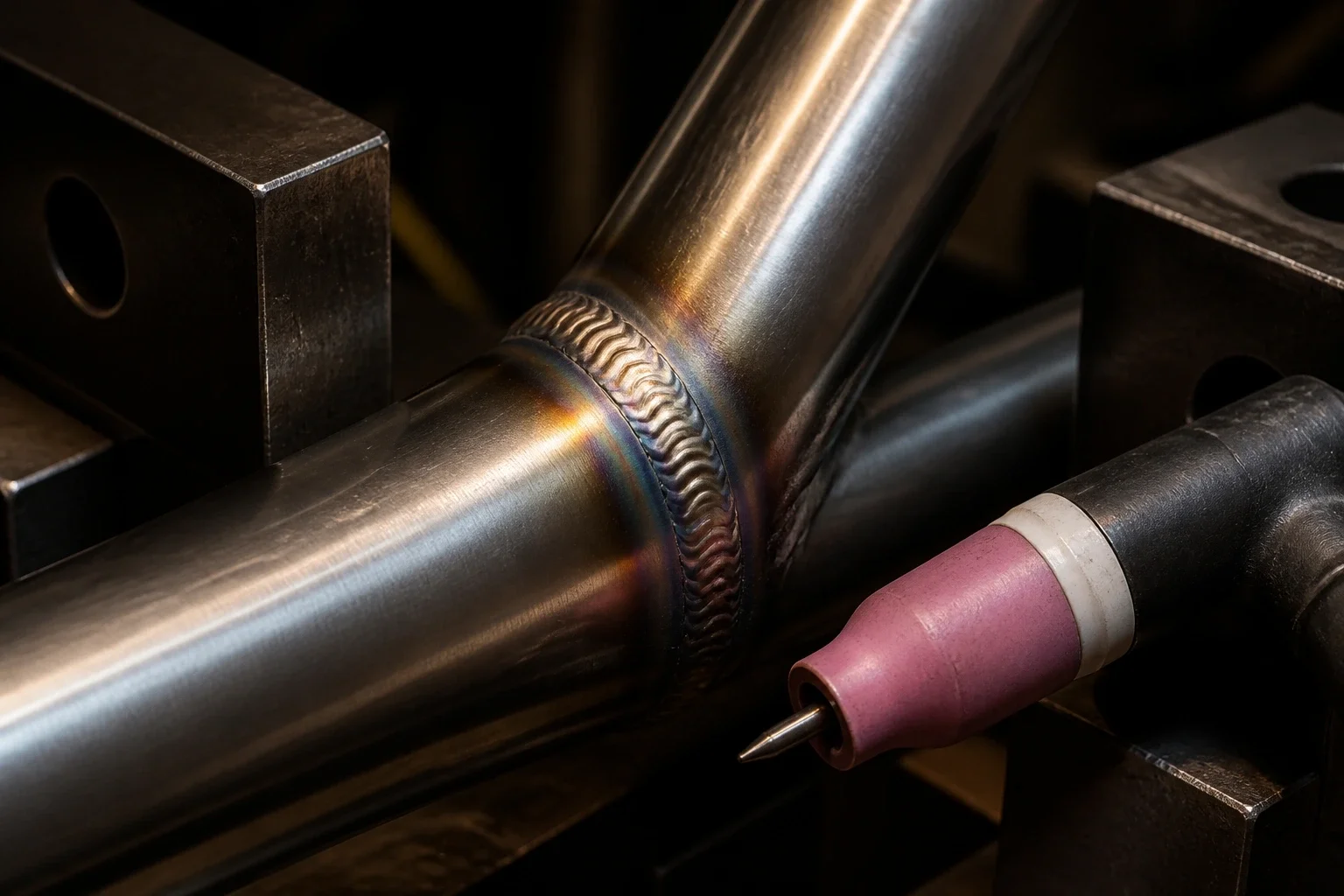
Stainless, aluminum, titanium, Inconel — materials that demand heat control and joint geometry. Custom frames, manifold assembly, development and prototype hardware, stress-critical joints.
ROTARY DRAW BENDING
Rotary draw bending on dedicated benders: motorcycle head pipes, coolant lines, structural tubing. The die carries the wall through the radius, so the bend holds its section instead of wrinkling or collapsing.
CUSTOM ASSEMBLY
Machined, welded and finished components integrated into complete functional assemblies. Drawings to delivery; fit and geometry checked before it leaves the building.
WHAT A GOOD JOINT IS ACTUALLY MADE OF
Four things, none of them a number.
THE COLOR ON THE JOINT IS INFORMATION
Heat tint on stainless says how hot the metal ran and how well the gas covered it while it cooled. A narrow band of straw and blue is a joint that was kept in control. A wide, dull rainbow is oxidation the shielding should have prevented, and it is treated as a defect here, never as a finish.
NO SMOKE. NO SPATTER.
A TIG weld throws no spatter and makes no smoke. The arc runs under argon, the filler goes in by hand, and the puddle is watched the whole way. If a joint smokes, the material was dirty or the gas was not covering it — and either one shows in the bead long before it shows under load.
THE DIE CARRIES THE WALL
In a rotary draw bend the tube is clamped to the die and drawn around it, with the follower behind the bend keeping the outer wall supported. The wall is carried through the radius instead of pushed into it, so the section stays round and the inside of the bend does not fold. A collapsed bend is a restriction; a wrinkled one is a stress riser.
THE JOINT IS DESIGNED BEFORE IT IS WELDED
Fit-up decides the weld before the arc starts: a tight, even fit the whole way round with no daylight in the joint, a machined face where the tube meets the flange, a fixture that holds it there while it cools. That is why the welding sits in the same building as the machining — the flange is bored and faced here, so the joint it makes was designed, not improvised.
WHERE THIS WORK GOES
Frames, subframes, head pipes — and the one-off stranger than any of them.
The tube and pipe work here is motorcycle work: flat-track and motocross frames, subframes and tube chassis, exhaust head pipes, brackets and exhaust flanges. The pedigree behind it is factory-level racing, frame building and exhaust welding, and it is the reason the bar sits where it does. The shop does not build car exhaust systems. It builds the one-off that is more unusual than a car exhaust, and the development hardware that gets welded once and tested hard.
The machining is the identity here — five-axis, turning, the mold-and-die platform. Fabrication is the sector that proves its range, and the welding exists because a machined part is often only half of the assembly it belongs to. A bracket bored on the machine and welded to a tube in the same fixture is one job with one drawing set, and nobody hands it to a stranger halfway through.
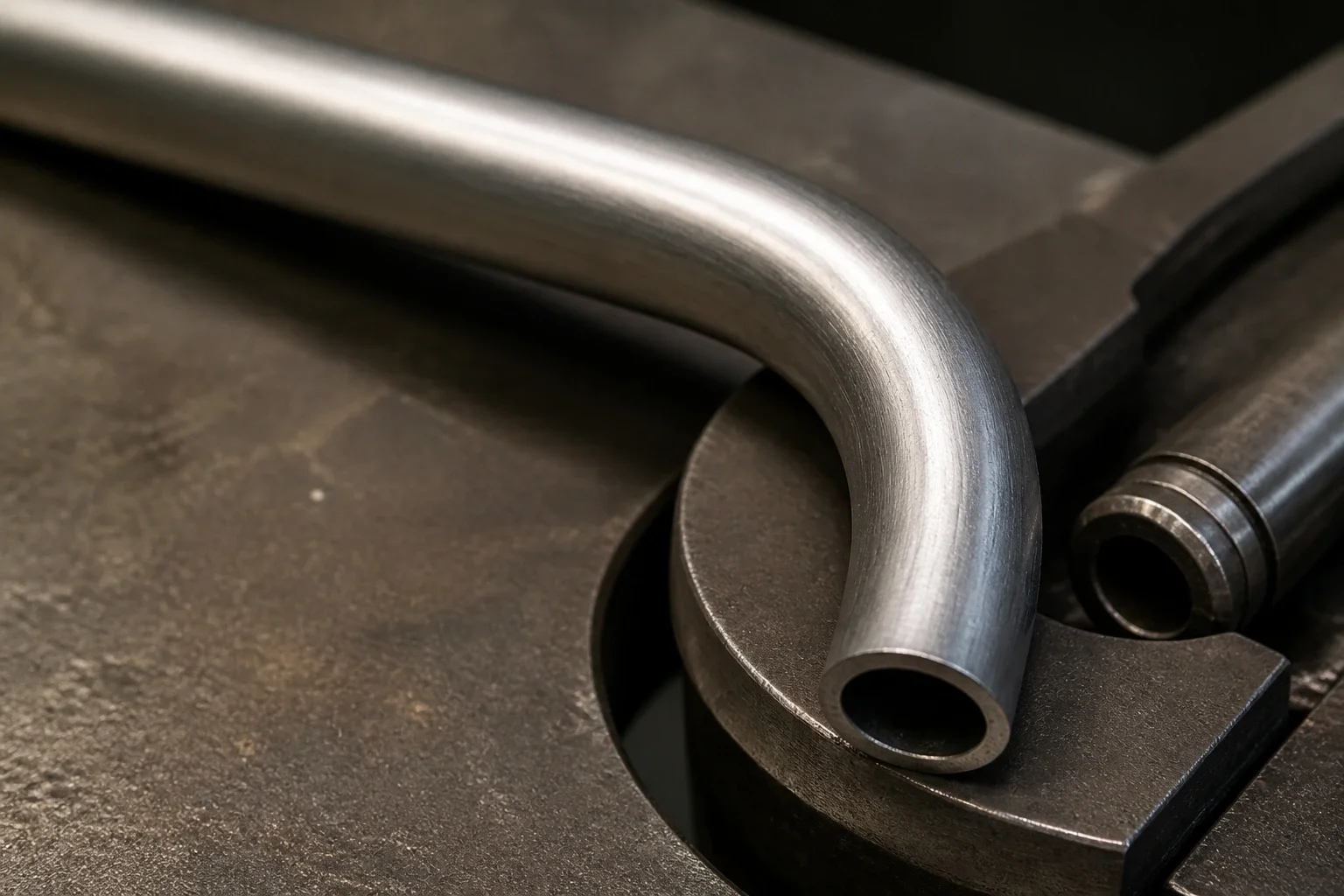
MID-BEND
Around the die the wall stays round through the radius — no flat on the outside, no fold on the inside. That is the die doing its job.
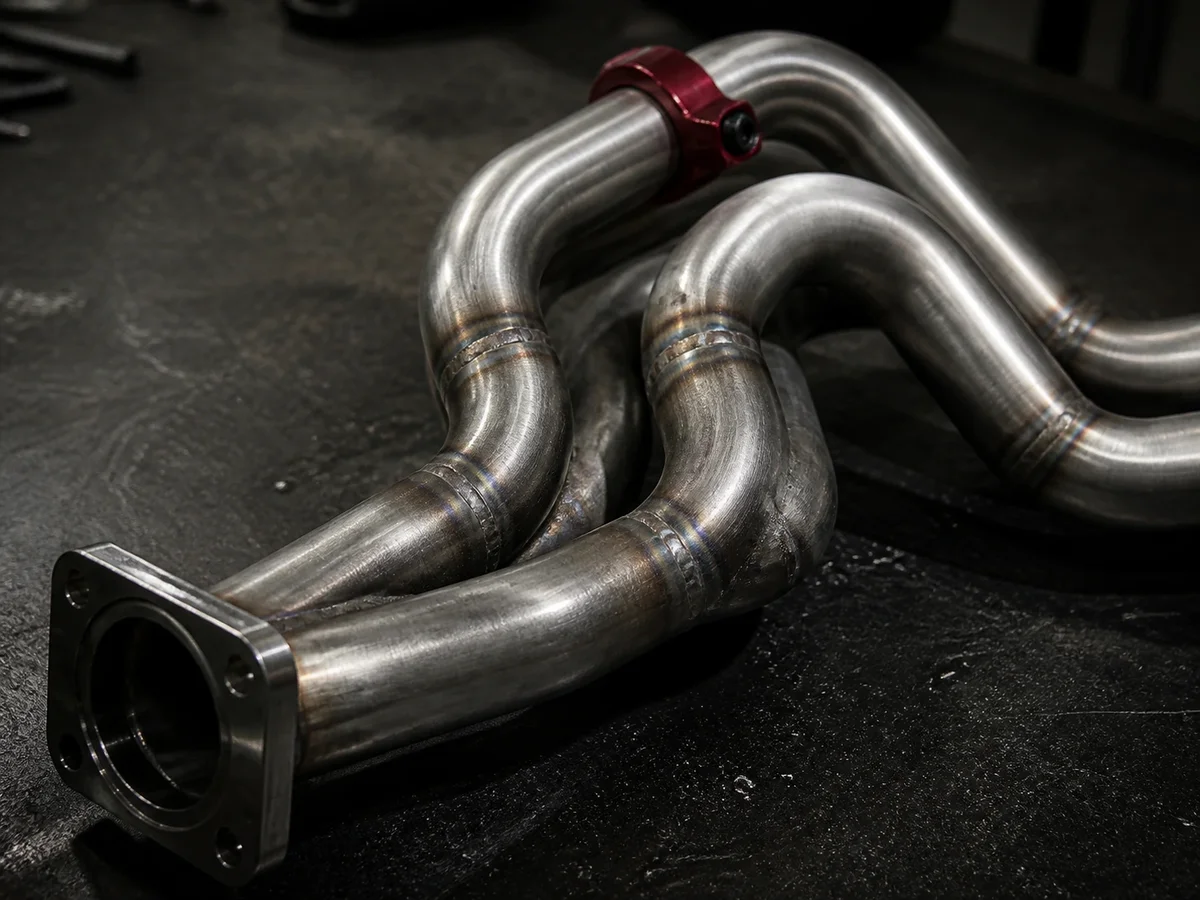
BENT, WELDED, FLANGED
Two runs merged into one at a four-bolt flange — flanges like it are machined in the building where the welding is done.
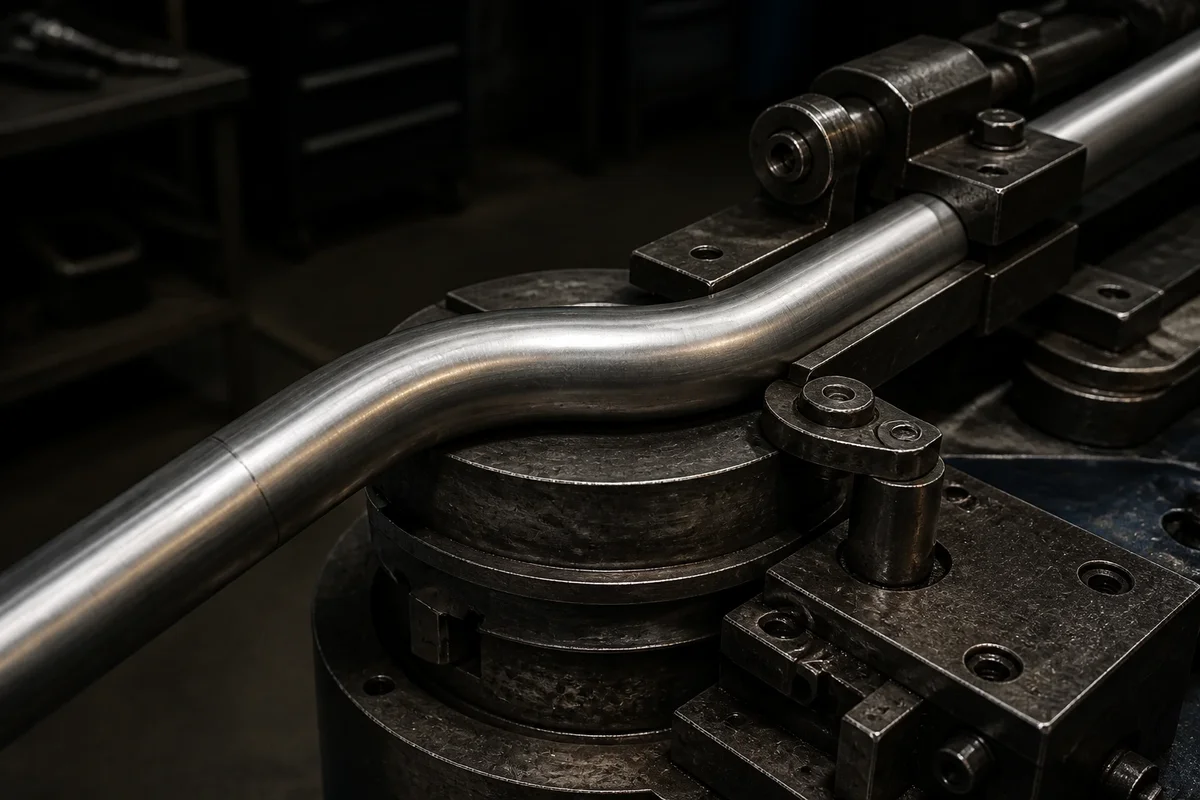
STILL IN THE BENDER
An offset bend held in the tooling that made it — no wrinkle on the inside, no flat on the outside.
ASKED BEFORE THE PART IS SENT
Four questions, answered straight.
Do you build car exhaust systems?
No. Tube and pipe work here is motorcycle work — head pipes, frames, subframes, brackets and flanges — and the one-off more unusual than a car exhaust. A full car exhaust is the wrong job for this shop, and so is repairing a cracked pipe or frame: the work here is built new, to a print. It is better to say so than to quote it.
Which materials do you TIG weld?
Stainless, aluminum, titanium and Inconel. Each has its own rules for heat and shielding — the alloy on the print sets the heat, the filler and the gas — and a joint in titanium is planned differently from the same joint in stainless. That is the point of doing it in the shop that machined the part.
Is the welding done in the same shop as the machining?
Yes. One building: the flange is machined, the tube is bent, the joint is welded and the assembly is measured in the same place, and the print stays with the same people the whole way. Nothing is handed to a stranger halfway through.
What does rotary draw bending change for my part?
The tube keeps its section through the bend. The die carries the wall around the radius instead of pushing it, so the inside of the bend does not wrinkle and the outside does not flatten — a bend that flows the way the drawing assumed, and one that carries no wrinkle to start a crack under vibration.
Send the print, or the tube, or the part it has to bolt to.
The shop reads it against the material, the joints and the bends it needs, and comes back with a real path — including the part we would rather machine than weld.