ONE SETUP · ONE DATUM · EVERY FACE
Five axes exist to end the second setup.
PROTOTYPE & R&D · FIVE-AXIS SIMULTANEOUS · GRAND RAPIDS MI
THE SHORT ANSWER
The part moves too — that is the whole idea.
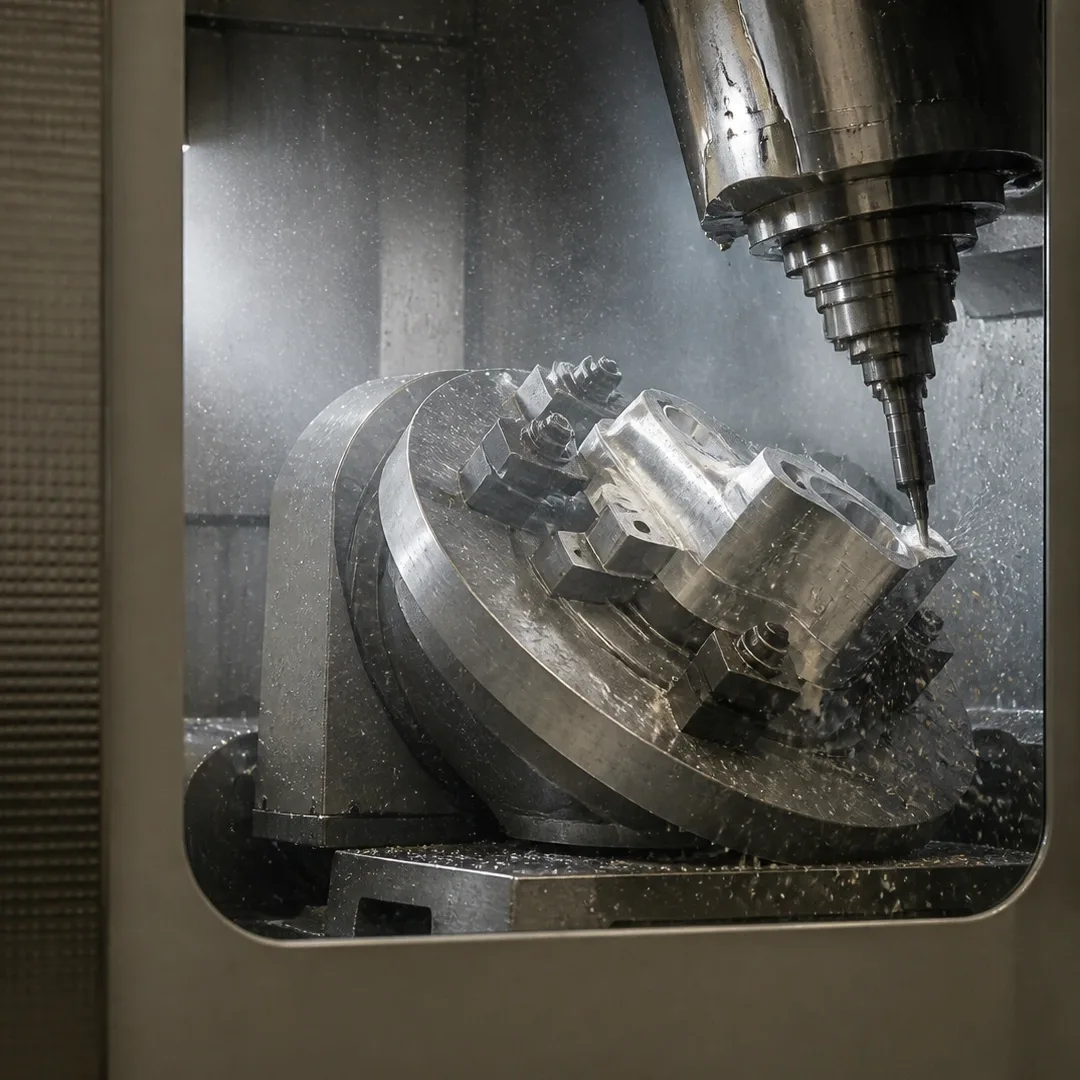
Five-axis machining means the part tilts and rotates while the tool is cutting. That removes the flip — the moment a part is unclamped, turned over and indicated again — and with it the stack of small errors every flip quietly adds between one face and the next. The part comes off having been held once, referenced once, and cut from every direction it needed.
That is the entire argument. Everything below is what it costs, where it does not apply, and what changes on the floor because of it.
WHAT THE FIVE AXES ARE
Three linear and two rotary. X, Y and Z move the tool through the space. The two rotary axes tilt and turn the work inside it. Five of them moving at once is what lets a cutter stay square to a surface that is not square to anything — the definition matters because that is the only thing five axes buys you, and it is enormous.
IS IT FASTER? NOT WHERE YOU THINK
Not per cut. Per part, nearly always — because the time a part loses is not in the cutting, it is in the setups between the cuts. Three setups means indicating three times, proving three times, and three chances to pick up the wrong reference. Remove them and the cutting time barely moves while the part arrives sooner.
WHERE IT IS THE WRONG MACHINE
A flat plate with four holes does not belong on a five-axis, and neither does anything a vise and one setup already solve. The machine earns its place on geometry that cannot be flipped — undercuts, compound angles, blended surfaces, features that reference each other across faces. Putting simple work on it is paying for an axis nobody turns on.
THE REAL DISADVANTAGE IS WHAT A MISTAKE COSTS
With five axes moving together the tool, the holder, the fixture and the machine itself can all reach each other. So the collision work happens in software before anything spins, the tools are measured off the machine before they go in, and the part is checked against the print before it is unclamped. The difficulty is real and it sits with the shop, not with your drawing.
WHAT IT CHANGES ON THE FLOOR
Four things, none of them the spindle.
The machine is the least interesting part of this. What a five-axis platform actually changes is how the job is planned before a tool is ever chosen.
THE DATUM IS PICKED ONCE
Every feature on a five-axis part is cut from one reference. On a three-axis part the second setup inherits the first one's errors, the third inherits both, and the drawing's relationship between two faces quietly becomes the sum of however many times the part was re-indicated. One datum means that stack never starts.
THE TILT IS THERE TO SHORTEN THE TOOL
Tilting the work lets a short, stiff cutter reach into a pocket that a three-axis machine can only get at with a long one. A long tool deflects, chatters, and leaves the wall it was supposed to hold. Most of what looks like five-axis magic in a finished part is really this: the same cut taken with a tool short enough not to bend.
THE FIXTURE IS PART OF THE PROGRAM
A part that swings has to clear everything while it swings. So the clamps, the risers and the way the billet sits are decided with the toolpath rather than before it — and a job that arrives as a solid model is fixtured on the screen first, where moving a clamp costs nothing.
IT COMES OFF FINISHED, OR IT DOESN'T COME OFF
Because there is no second setup to catch anything, the checking happens while the part is still on the table and still on its datum. If a feature is out, it is corrected where it was cut. That is the trade the single setup demands, and it is why the operation is planned much further ahead than a three-axis job.
◆Why the part tilts
Three axes · a long tool, a second setup
Five axes · a short tool, one datum
Three axes · a long tool, a second setup
Five axes · a short tool, one datum
THE TILT SHORTENS THE TOOL
The wall is brought to the cutter, so a short, stiff tool reaches it instead of a long one that bends.
ONE DATUM
Every face is cut from the reference the part started on. No second setup inherits the first one's error.
NO FLIP
The part is held once and referenced once, then cut from every direction it needs.
THE QUESTIONS PEOPLE ACTUALLY TYPE
Five of them, answered without a brochure.
What are the 5 axes of machining?
Three linear axes and two rotary ones. X, Y and Z move the cutting tool through space; the two rotary axes tilt and turn the part while it is being cut. A three-axis machine can only approach a part from one direction at a time, so a face that is not facing the spindle has to wait for the part to be unclamped and turned over. Five axes remove that wait.
Is 5-axis CNC machining faster?
Not in the cut — in the job. A five-axis toolpath is not inherently quicker than a three-axis one, and it is often slower per pass. What disappears is the setup time between operations, along with the re-indicating and re-proving each setup needs. On a part that would otherwise take three or four setups, that is the majority of the time the part spends in the shop.
What are the disadvantages of 5-axis machining?
Programming takes longer and a mistake is more expensive, because with five axes moving together the tool, the holder, the fixture and the machine can all collide. It is also the wrong machine for simple work — a flat plate with four holes gains nothing from it. The honest answer is that five axes solves a specific problem, and putting a part on it that does not have that problem is waste.
What kind of parts actually need it?
Parts whose features reference each other across faces, and parts that cannot be flipped without losing that relationship: undercuts, compound angles, blended and swept surfaces, ports that enter at one angle and exit at another, and anything where the drawing ties a face on one side to a face on the other. If a part can be made accurately in one setup on a three-axis machine, it should be.
Can a part come from outside Michigan?
Yes. The five-axis work happens here in Grand Rapids, and a part can be posted in from any state; the model or the print comes by upload or by email.
Send the model. The setups are our problem.
The shop reads the geometry for what actually has to happen in one setup and what does not — including the part we would rather cut on three axes, because it does not need five.