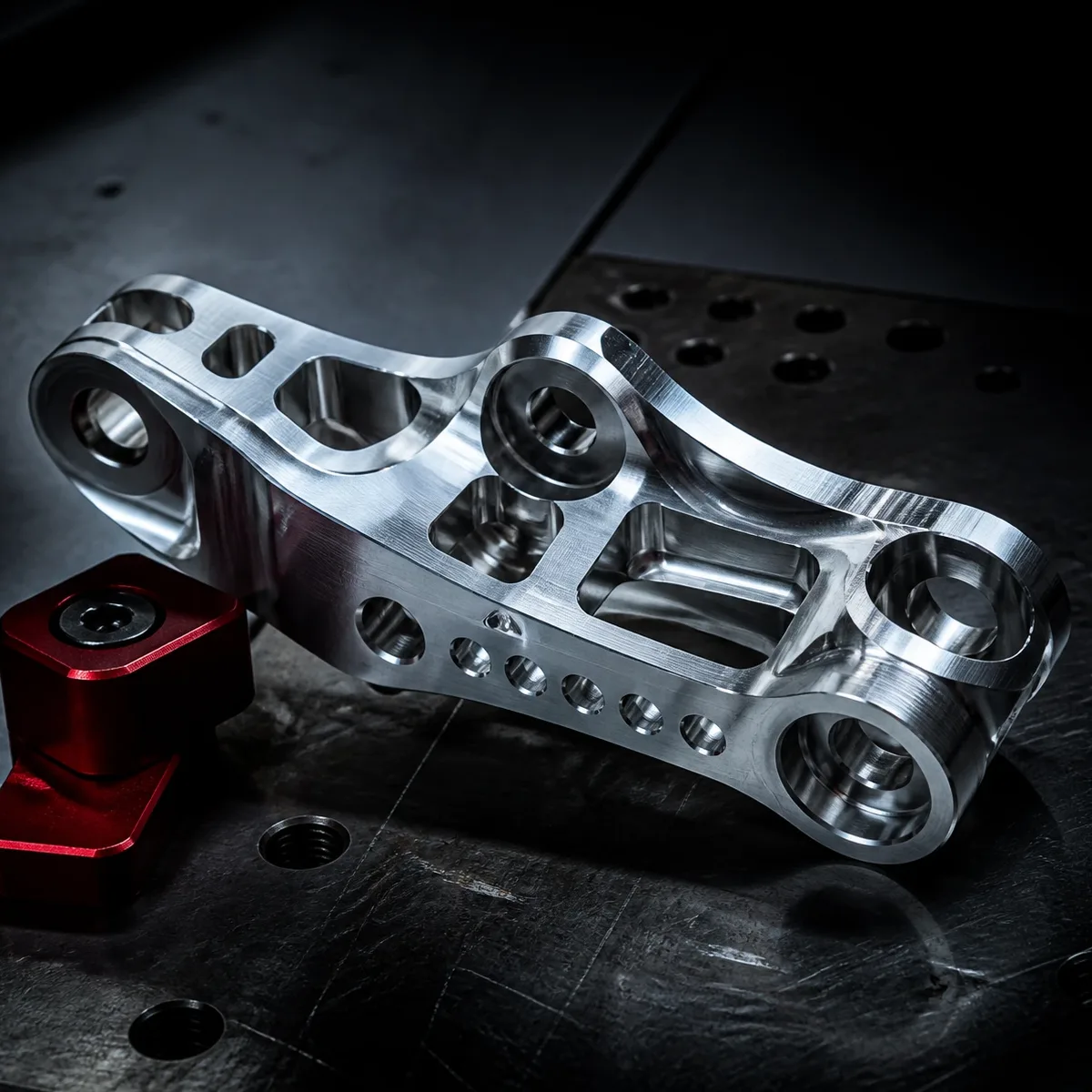
WHAT CHANGES AT THE EDGE · HOW A SHOP SETS UP FOR IT
Titanium keeps the heat at the edge.
RIGID HOLD · SHARP EDGE · STEADY FEED · COOLANT ON
WHAT CHANGES WHEN THE MATERIAL IS TITANIUM, AND HOW DOES A SHOP SET UP FOR IT?
Titanium is machined with a different discipline from steel because it keeps the heat at the edge of the tool, springs away from a dull tool, and work-hardens under an edge that rubs. What changes is the setup: a rigid hold, a sharp edge, a steady committed feed, flood coolant on the edge, and a cut that never dwells.
By Cyclone Machining Co.Updated
◆01·WHAT IT IS
Titanium, for a machinist.
Titanium is a light, strong, corrosion-resistant metal that keeps its properties across a wide temperature range and is tolerated by the human body, which is why aerospace structure, medical implants and instruments, racing hardware and chemical plant all reach for it. It is machined here to the alloy the print calls for, and that alloy and its condition are read from the print before a number goes back, because together they decide the setup.
Compared with steel, titanium has a lower stiffness for its strength, a much lower thermal conductivity, and a strong appetite for reacting with whatever touches it at temperature. None of these is a flaw in the material. Each is a fact the setup has to answer, and a shop that answers them cuts titanium as ordinary work.
◆02·WHAT CHANGES
Five things change at the edge.
The heat stays at the tool. In steel a large share of the cutting heat leaves in the chip. Titanium conducts heat so poorly that it concentrates in a small zone at the tool's edge and flows into the tool, so the edge runs hot even at modest speeds and wears by the heat rather than by the load.
The part springs away. Titanium's low elastic modulus means it deflects under cutting force more than steel does, then springs back. A thin wall chatters, a bore comes out tapered, and a light finishing pass taken to clean a wall may not cut at all: the part moves away from the edge, the edge rubs, and rubbing is the one thing titanium punishes.
The tool is attacked chemically. At cutting temperature titanium reacts with the tool material itself, so the edge wears by diffusion and cratering as well as by abrasion. Speed multiplies it, which is why titanium is cut at speeds that would look slow for steel and fed firmly enough that the edge is always under fresh metal.
The chip is segmented. Titanium forms a sawtooth chip, and each segment is a small hammer blow on the edge. The force rises and falls with every segment, which drives chatter in anything not held rigidly, and the chip itself is thin, hot and sharp.
The surface hardens under a rubbing edge. Titanium work-hardens less than Inconel, and its skin still hardens under a tool that dwells or rubs. A feed that is wrong for titanium burns the edge, and the surface it rubbed is harder and hotter than the one the print described; the next tool pays for it.
◆03·THE SETUP
Controlled engagement, coolant on the edge.
Hold it rigid. Deflection is the enemy in titanium, so the part is held as close to the cut as the geometry allows and the tool is kept as short as the reach allows. Every face reached from one datum keeps the part from being unclamped and re-clamped between operations, and on a compound angle the five-axis head is tilted to the geometry rather than the part re-fixtured under a longer tool.
Keep the edge sharp and known. A dull edge in titanium rubs, and rubbing heats and hardens. The length and diameter of every tool are read on the pre-setter before it cuts, and holders are chosen for runout, because an edge that wobbles rubs on half of its revolutions.
Feed steadily, and commit. The load on the edge is kept from spiking in a corner by controlling how much of the tool is in the cut through the whole toolpath, and the feed is kept firm enough that the edge is always cutting fresh metal rather than sliding on metal it already touched. A pass that has to end ends in air, not in the wall. Coolant is aimed at the edge and kept on, because heat that cannot leave with the chip has to leave with the coolant.
Let the finish come off the cut. With the tool contact kept square to the wall, the surface finish is produced by the finishing pass rather than by a later operation that would rub. On a fatigue-loaded titanium part that matters more than it does in steel: a rubbed, burnished surface is a worse surface than a cleanly cut one, whatever it looks like.
Probe it in the cycle. Features are read while the part is still clamped, so deflection and tool wear are caught as drift in a reading rather than as a scrapped part, and the critical features are read again off the machine before it ships. No cutting speed and no feed are printed here, for the reason the Inconel page gives: the setup decides the number.
◆Why the part springs away
Steel · the wall holds, the edge cuts
Titanium · the wall bows, the edge rubs
Steel · the wall holds, the edge cuts
Titanium · the wall bows, the edge rubs
THE PART SPRINGS AWAY
Titanium deflects under the cutting force more than steel does, then springs back; a light pass may not cut at all, and a rubbing edge is the one thing titanium punishes.
HELD CLOSE, TOOL SHORT
The part is held as close to the cut as the geometry allows and the tool kept as short as the reach allows, so the deflection has nowhere to go.
THE FEED COMMITS
Firm enough that the edge is always under fresh metal, with coolant on the edge; a pass that has to end ends in air, not in the wall.
◆04·THE CHIP
Why the chips matter, and why an angle grinder is the wrong tool.
Fine titanium swarf and grinding dust can ignite, and once burning they burn hot and do not go out easily. An angle grinder on titanium makes exactly that material, in a spray, next to a spark. It is the wrong tool for titanium for that reason before any other, and a cut-off wheel on a plate is a job for a saw with coolant, not a grinder in a vise.
At a machine the chip is controlled rather than feared: flood coolant keeps it cool, it is evacuated rather than left to pile up fine and dry in a corner of the enclosure, and the machine is cleared between materials. Magnesium, which burns more readily still, is cut here under the same discipline, and titanium inherits it.
◆05·THE HONEST LIST
What a weakness of titanium actually is.
Titanium is notch sensitive: a scratch, a tool mark or a rubbed surface on a fatigue-loaded part is where a crack starts, which is why the surface finish is a strength question and not a cosmetic one. It galls, against itself and against other metals, so threads and sliding fits need the right lubricant and often a different mating material. It is not stiff for its strength, so a titanium part flexes more than the same part in steel and a design that assumed steel's stiffness will move. It reacts with oxygen and with tool materials at temperature. And it costs more to buy and more to machine than aluminum or steel, because the cutting is slower and the tooling wears faster.
None of that is an argument against titanium. It is the list a print in titanium has already weighed, and the list a shop has to respect at the edge.
◆06·WHAT TO SEND
What the quote is built from.
Send the print or the model with the alloy and its condition on it, mark the features that matter, and say the finish in words. Without a drawing, the part itself is measured and the work goes from there. One part is a real job here, whether it is a prototype bracket, a replacement fitting or a fixture that has to survive a test.
The machine time runs longer than for the same part in aluminum, because the cutting is slower and the tools wear faster, and what that costs is read from the print, part by part. There is no price here and no promised date; a person reads the print before a number goes back.
THE QUESTIONS PEOPLE ACTUALLY TYPE
Asked by people holding a print in titanium.
7 answers. The questions typed before a titanium part is sent anywhere, in the words they are typed in.
Can you machine titanium?
Yes. Titanium is cut here by its own rules: rigid holding, a sharp edge, steady feeds and flood coolant, because it keeps the heat at the tool's edge and work-hardens under a tool that rubs. The alloy and its condition are read from the print first.
Why is titanium harder to machine than steel?
It carries heat poorly, so the heat stays at the tool instead of leaving with the chip, and it springs back under a dull edge. The answer is the setup, not the speed: hold it rigid, keep the edge sharp, keep the coolant on, and take a cut that does not rub.
Is machining titanium expensive?
It takes more machine time than aluminum for the same part, because the cutting is slower and the tools wear faster. What it costs is quoted from the print, part by part, like every job here.
Can titanium be cut with an angle grinder?
It should not be. Fine titanium swarf and grinding dust can ignite and burn hot, and a grinder makes exactly that in a spray beside a spark. Cut it on a saw with coolant, or machine it with the chip controlled and evacuated.
What is a weakness of titanium?
It is notch sensitive, it galls, it is not stiff for its strength, it reacts with oxygen and tool materials at temperature, and it costs more to buy and to machine than aluminum or steel. A print in titanium has weighed all of that already.
Does titanium work-harden like Inconel?
Less, and enough to matter. A tool that dwells or rubs hardens the skin it touched. The larger problems in titanium are heat held at the edge and a part that springs away from the cut, and all three are answered by the same setup.
Will you machine one titanium part?
Yes. A single titanium part is quoted from the print like any other job here. Send the print or the model, or send the part as it stands.
Sources
They support the general facts. The shop practice is its own.
- A study of tool wear when machining titaniumOpen access; its introduction sets out why the metal is hard on tools.
- Titanium chips and fines as a fire hazardA fire chief's briefing to the titanium industry association.
- OSHA on combustible dustMetal dust as an explosion hazard, with a titanium case among its examples.
Send the print, with the alloy and its condition on it.
The alloy and its condition decide the setup, and the setup decides the cut. Mark the features that matter, say the finish in words, and a person reads the print before a number goes back. One titanium part is a real job here.