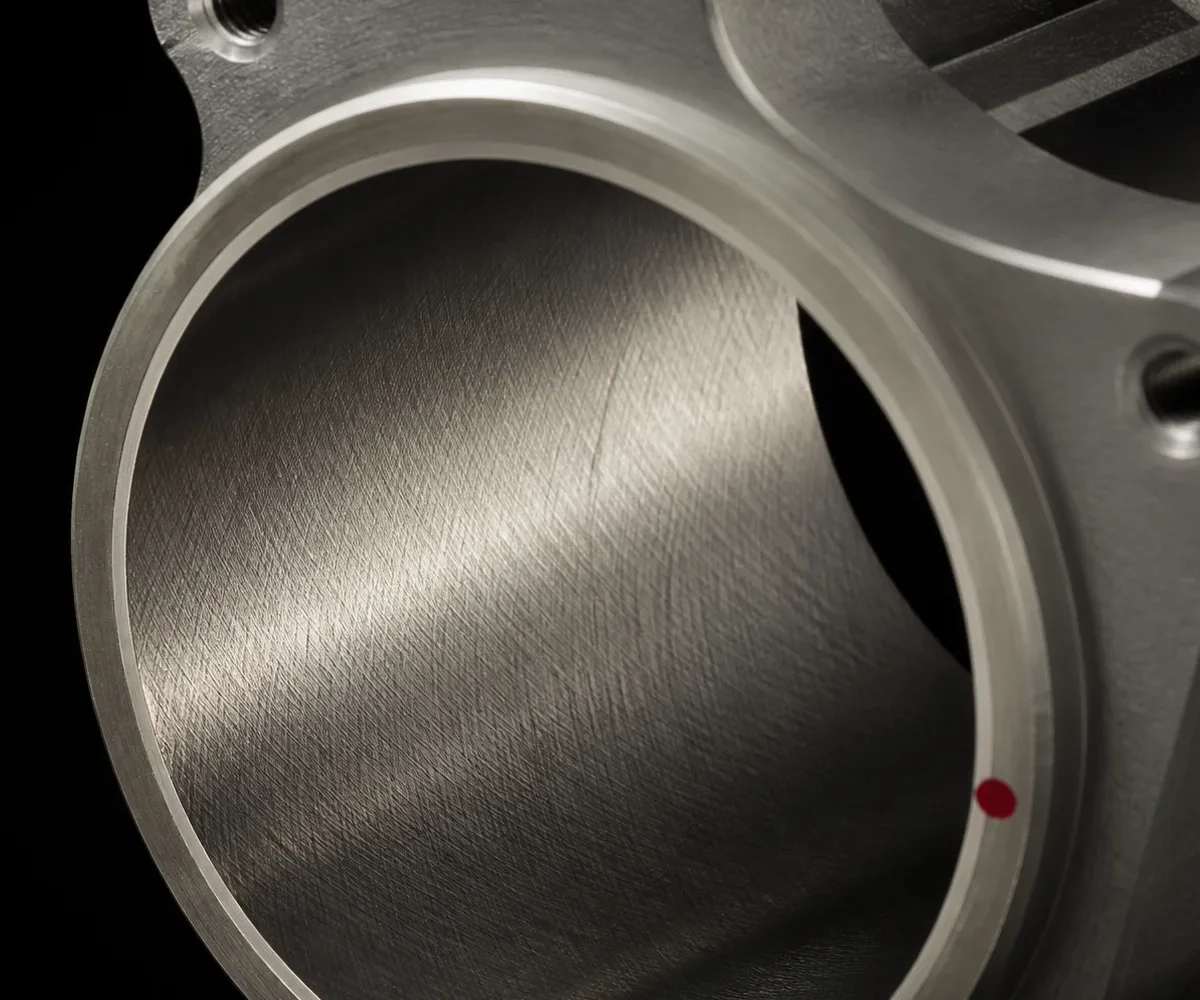
ROUNDNESS · STRAIGHTNESS · THE SAME BORE ALL THE WAY THROUGH
Honing is roundness and straightness.
A DEDICATED HONE · CROSS-HATCH, NEVER POLISH · GRAND RAPIDS MI
WHAT THE OPERATION IS ACTUALLY FOR
It is a circle, and it is the same all the way across.
Three properties, and a honed bore is judged on all three. The figure below carries no numbers on purpose — the numbers live on your print, and the point of the operation is that the part comes back agreeing with it.
◆The finished specification, per tubular length
SURFACE FINISH
The cross-hatch that holds oil where the seal rides.
ROUNDNESS
A true circle at every station, not just at the ends.
STRAIGHTNESS
The same bore all the way through the length.
WHY A BORE GETS HONED AND NOT BORED OR GROUND
Four reasons, all of them mechanical.
A BORED HOLE IS NOT A ROUND HOLE
Boring puts the hole where the print says. It does not make it round, and it does not make it the same size at both ends — the tool deflects, the part moves, the fixture has an opinion. Honing is the operation that takes a hole that is nearly right and makes it actually round, actually straight, and the same the whole way through.
THE CROSS-HATCH IS FUNCTIONAL, NOT COSMETIC
A honed wall carries two opposed families of strokes. That pattern is what holds oil against a moving surface. A wall worked smooth enough to shine holds none of it, which is why cross-hatch is what a correct honed bore looks like and why the smoother-looking alternative is not offered here.
A DEDICATED MACHINE, NOT A SHARED SETUP
Honing runs on its own machine here rather than as an attachment borrowed onto something else between jobs. That matters for the same reason a dedicated fixture matters: the setup is not being torn down and rebuilt around it, so the second part is the same as the first. The machine is a Sunnen.
IT IS THE LAST OPERATION, SO IT IS THE ONE THAT DECIDES
Everything upstream can be correct and the part still fails on the bore, because the bore is finished last and carries every error that came before it. Honing is where that gets resolved — or where it gets discovered, which is the more useful outcome of the two.
ASKED BEFORE THE CYLINDER ARRIVES
What gets asked before a cylinder comes in.
What gets honed here?
Cylinder bores, hydraulic sealing surfaces and precision journals — any bore where something runs, seals or turns against the wall and the fit depends on that wall being round and straight the whole way through. The bore is finished to the size on your print, and concentricity is held to what the design intends, not to what the last operation left.
Does honing change the size of the bore?
Yes. Honing takes metal off the wall — that is how it brings the bore to final size and makes it round on the way there. A bore already at the top of its size has nothing left for the hone to work with, which is why a bore that will be honed is left small for it, and why a worn cylinder is measured before anyone says what it can be brought back to.
Can the bore be machined and honed as one job?
Yes, and it is the better order. Boring or turning the bore and then honing it is one job on one drawing here: the bore is roughed and finished to leave the right amount for the hone, rather than honed as a rescue on a bore somebody else sized. Machined, honed and checked, with one point of contact.
What do you need to quote it?
The print, or the part itself if there is no print; what it is made of; and what runs in the bore. A used cylinder is measured as it stands before anything is promised, and what comes back is a path — including where the bore is today against the print, and what we would change if we saw a reason to.
What is honing for?
Honing is the last operation on a bore that has to be round, straight and to size at the same time. Boring or grinding gets it close; the hone takes the final metal off the wall with stones under controlled pressure and leaves the cross-hatch an oil film lives in. A cylinder wall, a hydraulic bore and a bearing seat all reach for it when the finish and the geometry both matter, and it is done here on a dedicated hone rather than as a polish.
WHAT COMES THROUGH THE DOOR
One cylinder is a real job.
Motorsport cylinders and development hardware are the work here, not an exception squeezed between production runs. A single bore, a matched pair, a part that has been apart before — all of it is normal. Bring the mating component if there is one; a bore is only correct relative to what runs in it, and the part in your hand is better evidence than a nominal dimension.
Honing sits inside the same building as the machining, the welding and the rest of the finishing, so a part that needs cutting before it needs honing does not get handed to a stranger halfway through. Critical features get checked while the part is still in its setup, and checked again off the machine. Probed in the machine. Proven off it.
Send the block, and say what runs in the bore.
Send the print as well if there is one. A single block is the job here, and the bore is honed for round and straight, not for shine.