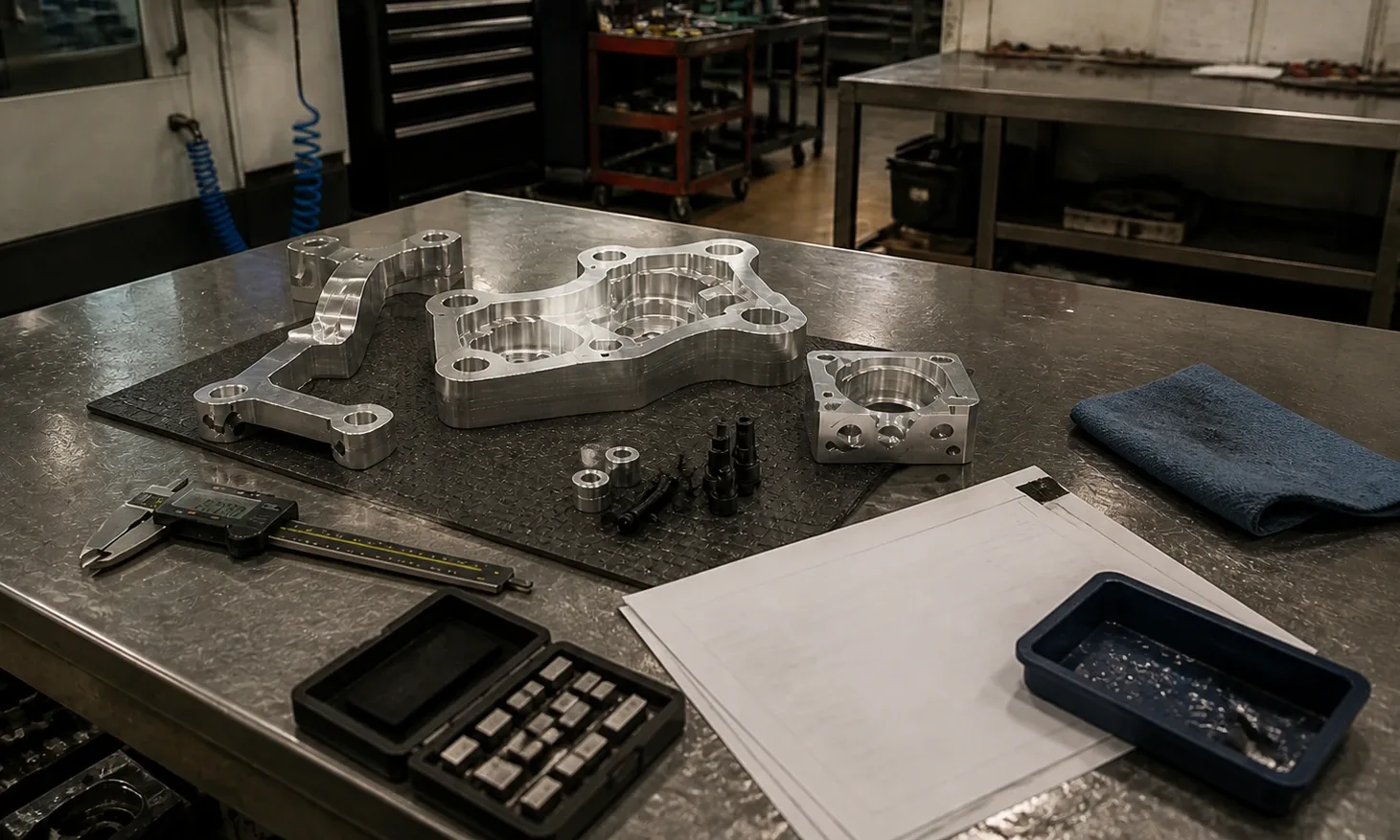
NO DRAWING · A SINGLE PART · THE JOB ANOTHER SHOP HANDED BACK
No drawing? The part is the drawing.
SEND THE PART · MEASURED ON THE CMM · GRAND RAPIDS MI
THE QUESTIONS THAT ACTUALLY GET ASKED
When there is no print.
11 answers, in the order they come up on the phone. They are specific because they are true.
By Cyclone Machining Co.Updated
- The part is discontinued and the supplier is gone.
- The shop that used to make it has closed.
- A drawing never existed, or it did not survive.
- The part failed in service and there is nothing to copy but the failure.
- The instant quote rejected the geometry.
- Another shop started it and handed it back.
◆The part is the drawing
THE PART IS MEASURED
With no print, the part is the drawing: the original is measured as it stands, and the fracture surface is information, so it is not cleaned up first.
THE GEOMETRY COMES FROM THE READINGS
It is measured on the CMM and the geometry comes from that; a worn face is read as a question, re-established from the faces that did not wear.
THEN IT IS CUT
One part is a real job here: the new one is cut to the part as it was designed to be, not as it is today.
Are you a broker, or do you make the parts?
We make them. Everything happens in one building on Clay Ave SW — the print is read here, programmed here, cut here, finished here and measured here, by the people who will answer the phone when you call about it. Nothing is quoted and then passed to a shop you were never told about. If a job genuinely belongs somewhere else you are told that instead of quoted, which is the same answer from the other direction.
Will you take just one part?
Yes. First articles and one-offs ARE the work here, not an exception squeezed between production runs. Development hardware, the single part another shop declined, the drawing everyone else handed back.
I have a broken part and no drawing.
Send the part. With no print, the part IS the drawing — the original gets measured and the work proceeds from that. Bring the failure with it if you have it; the fracture surface is information.
What if the instant quote rejects my part?
Send the same file here, unchanged, with the print and a line on what the part has to do. An automated quote turns away geometry it cannot classify: an undercut, a free-form surface, a feature that needs its own fixture before it can be cut. A person reads that here, and what goes back is either a route through the shop or a plain account of what would have to change first.
What do you need from me?
STEP is the working format. IGES, DXF and a PDF print upload with the form; native CAD comes by email to RFQ@CycloneMachining.com. Or the part itself. If there is no model and no drawing at all, the part gets measured on the CMM and the geometry comes from that.
Another shop gave it back.
Send it as it stands, and send what they gave you with it — the print, the part, the setup sheet, the inspection report if there is one. A job comes back for a reason, and the reason is information: a feature nobody could fixture, a wall that moved when it was cut, a tolerance that fought the material. The first thing that happens here is that it gets measured rather than re-started, because what the last setup did is worth knowing before anyone decides what the next one should be. Repair and rebuild means that here: a part that already exists and has to end up right — the unfinished job carried through, the damage the cut uncovered put back, the feature re-made to the print it was always meant to meet. Sometimes the honest answer is that the print needs a change, and you get told that instead of quoted.
How much does it cost to have a prototype machined?
It is quoted from the drawing, the model or the part itself. What moves the number is the material, the geometry, how many setups it takes to reach every face, the finish written on the print, and the inspection the print calls for. One part is quoted as a real job because it is one, and nothing here is priced from a table: send it, and a person reads it before the number goes back.
Can I mail you the part?
Yes, from any state. A part with no drawing is measured the same way whether it came through the door or out of a box, so pack it to protect the faces that locate it and the faces that wear. Put a note inside saying what the part does, what it mates with, and where it failed if it did.
What if the part is broken in pieces?
Send every piece. A part broken in two still carries almost all of its dimensions between the halves, and the break itself says how it failed, which decides what the new one has to be better at. Keep the fragments as they are; a cleaned-up fracture face is evidence thrown away.
Will the new part copy the wear?
No. A worn surface is read as a question, not as a dimension: which faces ran against something, which ones locate, and where the geometry as it stands has drifted from where it was meant to be. The part that comes back is the part as it was designed to be, not as it is today.
What if only a worn part exists and no new one?
Then the worn one is the reference and you tell us which faces ran against something. Those faces are treated as worn and re-established from the ones that did not, and where a mating part is the better reference than the sample, it is measured instead. Send the mating part too if you can spare it.
HOW A PART BECOMES A DRAWING
The original gets measured.
A worn part is not a nominal part, and that is the whole judgement. What comes off the CMM is the geometry as it is TODAY — after service, after wear, sometimes after the failure that brought it here. Turning that into a part worth cutting means reading which features are functional and which are consequences, and where a mating component is the better reference than the sample in front of you.
That reading is the part no FAQ page can fake, and it is why a sample arriving here is treated as evidence rather than as a template. Critical features get checked while the part is still in its single setup, and checked again off the machine. Probed in the machine. Proven off it.
WHAT TO SEND, AND WHAT THE PART TELLS US
The part answers half the questions. You answer the rest.
What to send
The part, and every piece of it if it broke. The mating part, if you can spare it, because a feature that has to fit something is measured against the thing it fits. A note on what the part does and where it failed. And whatever survives of a print, even a corner of one: a single dimension from the original drawing settles a question the sample cannot.
What the part can tell us, and what only you can
The part gives up its dimensions, its threads, its geometry as it stands today and where that geometry has worn. It cannot say which features locate or seal, what it mates with, what load it carries, or which surface ran against something for years. Those four answers are yours, and they decide which measurements are dimensions and which are symptoms.
A broken part is still a part
Two halves carry almost every dimension the whole one did, and the break carries the one thing a whole part cannot: how it failed. Do not clean the fracture faces and do not fit the halves back together; the surfaces where it let go are read before anything else, and what they say decides what the new part has to be better at.
When this is not the answer
A catalogue part you can still buy is cheaper bought. And an idea that exists only as a drawing of a wish is not a part yet: this page starts from a physical part or a real print, and a person will tell you which of those your job is before a number goes back.
◆BEFORE YOU ORDER ONE
Ask for two while the setup is up.
Most of the work in a one-off is not the cutting. It is the measuring, the deciding and the fixture — reading a worn sample, choosing which features are functional, building something to hold a shape that was never designed to be held. That work happens once. The second part borrows all of it.
So if the part is something that wears, or something a line stops for, say so when you send it. The fixture is what keeps part eight identical to part one, and the cheapest time to make part two is while part one is still on the machine. Telling you that costs a second phone call later, which is the point.
WHAT HAPPENS NEXT
A read, not a form response.
A name, an email and a line on what the part is will send it — “not sure” answers the material and the quantity. The shop reads it against what the part actually has to do and answers with a route through the shop — including the step we would take differently, and why. One shop, one building: the print is read, programmed, cut, finished and measured inside it, and nothing is handed to a stranger halfway through.
Sources
They support the general facts. The shop practice is its own.
- What a coordinate measuring machine isA probe senses points on the part's surface, one at a time.
Send the part, or the print, or both.
Send the part, the print, or neither. What comes back is a real route through the shop, written by the people who would cut it.