
Vapor Blasting · Grand Rapids, Michigan
Wet or dry is a decision. Not a preference.
Cyclone runs both cabinets. Which one your part goes into is not a house style — it depends on one question, and most shops never ask it because they only own half the answer.
What happens to the part next?
- Vapor blasting
- Dry blast cabinet
- Honing
- Shot peening
- Grinding
- Hand surfacing
Two cabinets. One right answer.
Water carries the media in.
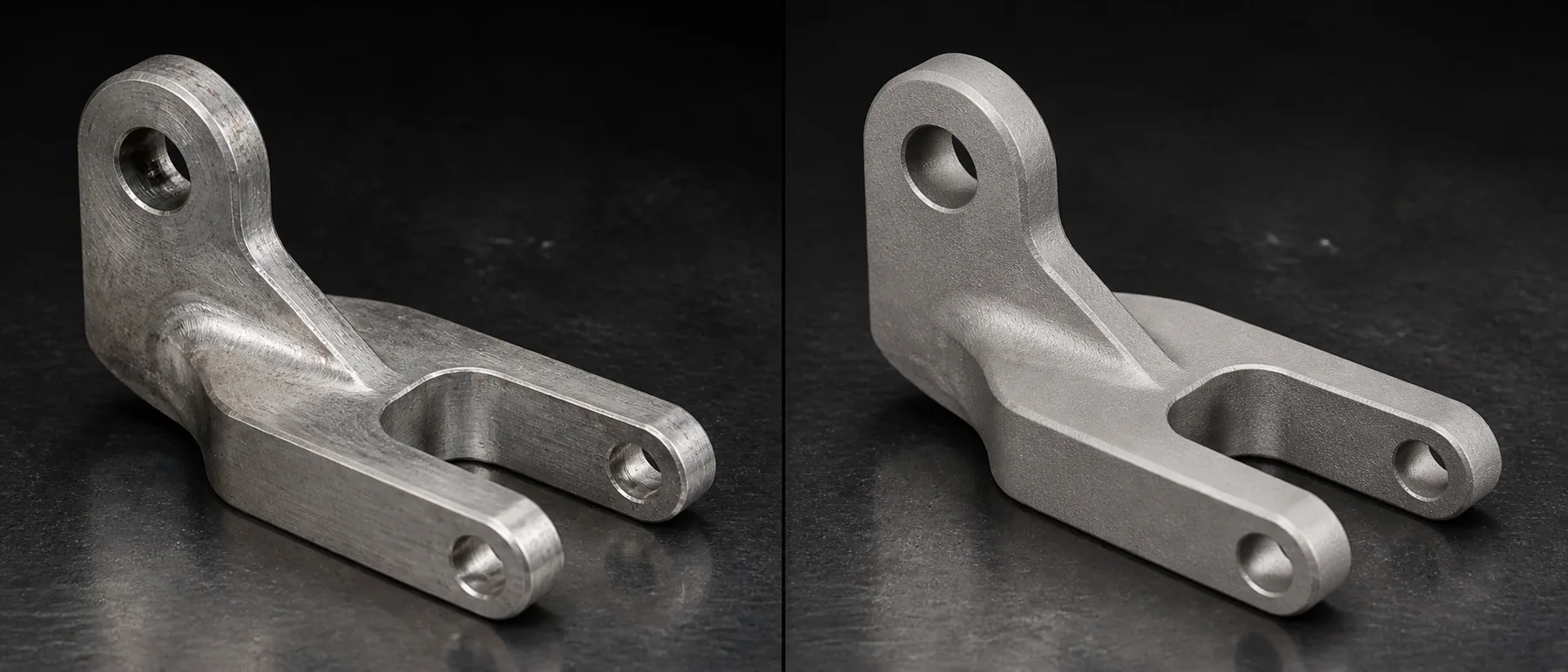
The water cushions the impact and turns it into a lapping action across the face instead of a strike. The surface comes out even and non-directional — it reads the same from every angle, because there is no lay to catch the light.
Nothing embeds in the part, and the cabinet makes no dust.
Aluminum, zinc and the softer alloys. Anywhere the surface has to look uniform and nothing may be left behind in it.
Media hits the surface and bites.
A direct strike cuts a tooth into the face. That texture is not a compromise — for anything going into a coating it is the point, because a coating needs something mechanical to hold onto.
It leaves an anchor profile a coating can key into.
Parts heading for paint, powder or anodize, where the finish underneath has to grip.
Sometimes the answer is the other cabinet.
- It goes to coating.
- Then it goes in dry. Vapor blasting leaves the face too smooth for a coating to key into, and a coating that cannot grip fails later, on someone else's bench.
- It's steel, and it's going to sit.
- Wet blasting leaves steel clean, reactive and damp, and flash rust does not wait for the end of the shift. Steel comes out of the cabinet and gets dried and treated. It does not get left on a bench to bloom.
- It needs colour.
- Anodize is arranged for you, in any colour you need. Tell us before the part is blasted, because the finish underneath decides how the colour sits.
Asked before it goes in
Does it change the size, or round an edge?
No. The media arrives in water and works across the face as a lapping action rather than a cut, so burr and scale come off and the surface evens out and nothing you would measure comes off the machined size. An edge stays an edge with the burr gone; a thread or a sealing face comes out clean and still to size — which is what lets a finished part go in last rather than first.
Can you blast a part you did not machine?
Yes. A part machined elsewhere that only needs its surface is a normal job here, not a favour — send the part, say what it is made of and what happens to it next, and it goes into the right cabinet. The same goes for a part that has been in service and comes in carrying scale.
Will the second part match the first?
Yes. The finish is a set of cabinet settings — media, pressure, time under the gun — not a judgement made at the window, and those settings stay with the job. A matched pair reads the same across the bench, and part two comes back the same satin as part one without anyone re-learning it.
What if the blast finds damage?
Then you get a photograph and a call before anything else happens to it, and the decision is yours. That moment is the real difference: oxidation and carbon hide a pulled thread, a fretted mating face, a hairline by a boss — and a blast is what uncovers them. A shop that only cleans has to hand the part back and tell you to find someone else. Here the hone, the shot peening, the TIG, the five-axis machine and the hand work are all in the same building, so the part carries on to whatever it actually needs instead of going into another box.
Can I send a part from another state?
Yes — parts arrive here by post from anywhere in the country, and a part that has travelled is treated no differently from one carried in by hand. Put a note in the box with it: what the metal is, what the part does, and what happens to it after blasting. That last one decides the cabinet, because a part going into a coating wants a tooth on it and a sealing face wants the opposite. If the part is going to sit for a while before it comes back to you, say so — a freshly blasted surface is a chemically clean surface, and bare steel left open will start to turn.
Is vapor blasting better than sandblasting?
For a part that has to stay to size and come out an even satin, yes. Vapor blasting suspends the media in water, so it cleans by lapping rather than by impact: scale and burr come off, the finish evens out, and nothing bites into the face or leaves grit embedded in it. Dry blasting is the harder hit, and it has its own job — it cuts an anchor profile into the surface for a coating to key into — which is exactly the wrong thing to do to a sealing face, a bore or a thread. What happens to the part next decides the cabinet, so say what it is going into.
How much does vapor blasting cost?
It is quoted from the part: its size, what it is made of, what is on the surface now and what the surface has to become. A person quotes it, not a table, so send the part with a note in the box saying the finish you need, and the answer comes back for that part rather than for a category.
You are not buying one part. You are buying the second one.
Development work does not stop at a finished part — it stops when the part is right. Ask a shop how they handle the one after this and watch how long it takes them to answer.
- PART ONE
It comes back finished.
Machined, blasted, inspected and approved, in your hands as a real part — not a sample of a process. You put it in the assembly and you find out what you actually have.
- PART TWO
Something changes.
A radius, a bore, a face, a finish. Send the change. The fixturing is still set, the program is still here, and so is the record of how the first one was finished — so the second one differs where you meant it to and nowhere else.
- PART THREE
Nobody is re-learning your part.
By the third one the setup is known work. That is the whole reason to run development at one shop instead of re-explaining a part to a new quoting desk every time it moves.
Send the part, or send the print.
Three things get a real answer back. Everything else we will work out on the phone, the way it actually happens.
- 01
The part, or the drawing
- 02
What it is made of
- 03
What happens to it after blasting
Finishing runs alongside the machining here, so a part does not leave the building to get its surface. See the rest of the finishing work. If the blast uncovers something, what happens next has its own page.