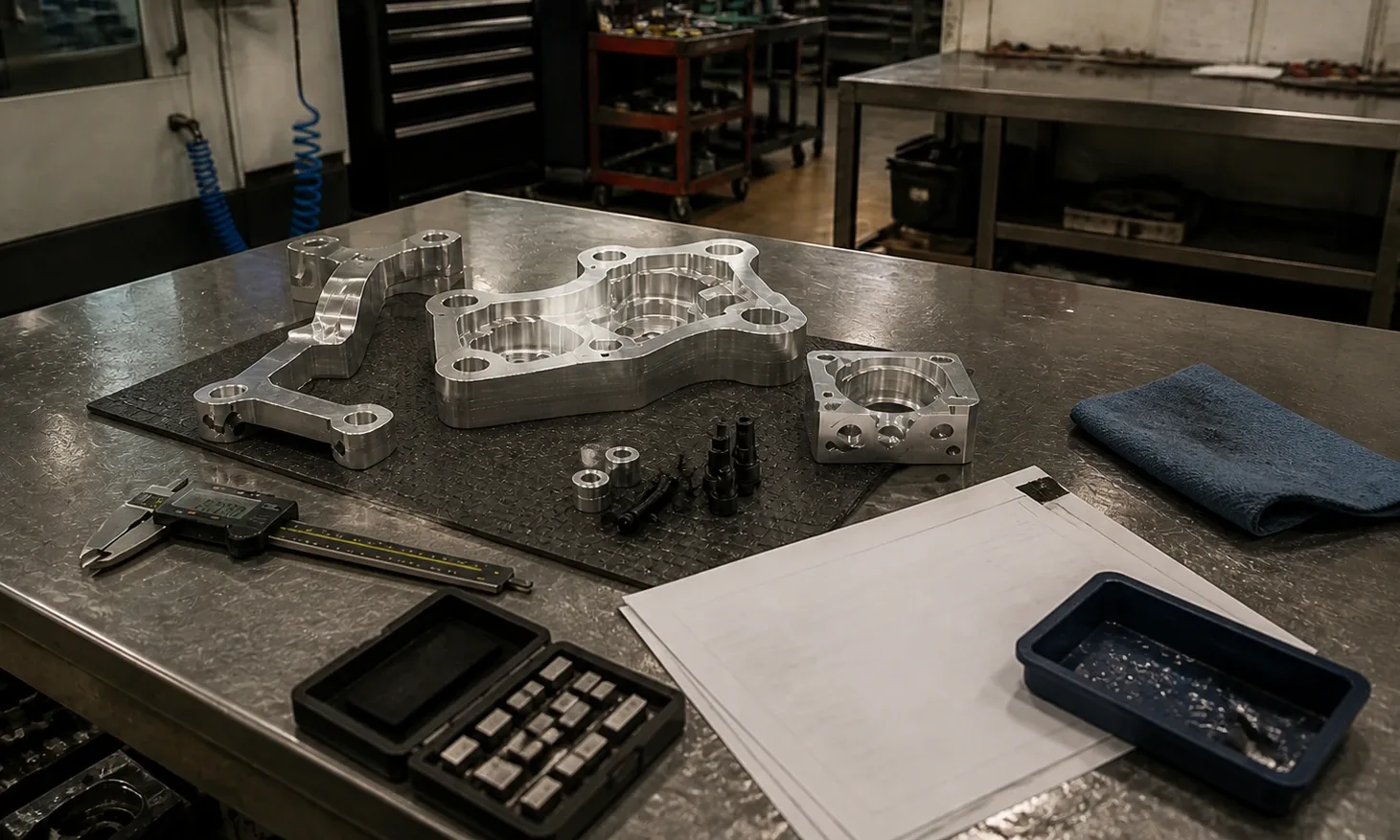
THE FIRST PART PROVES THE PROCESS · NOT JUST THE PART
Every critical feature has a number.
PROBED IN THE MACHINE · PROVEN OFF IT · GRAND RAPIDS MI
WHAT A FIRST ARTICLE ACTUALLY IS
Four things happen, in this order.
No form numbers below, and that is deliberate. What matters to the person waiting on the part is what was done to it and what was written down — a page reciting a document revision tells you nothing about whether the work was any good.
THE FIRST PART IS A TEST OF THE PROCESS
A first article is not a sample. It is the part that proves the setup, the fixture, the datum scheme and the program can produce the drawing repeatedly. If it passes because somebody nursed it, it has proved nothing — and that shows up on part twelve, not part one. A quantity of one is inspected the same way, as the first of a run, because the next revision starts from that record and not from memory.
EVERY CALLED-OUT FEATURE GETS A NUMBER
Each dimension the print calls out is measured and recorded against its callout. Not a spot check, not the three that looked risky — the ones the drawing asks for. A feature nobody wrote a number against is a feature nobody checked.
PROBED IN THE MACHINE, PROVEN OFF IT
Critical features get probed while the part is still in its setup, because that is the only moment a correction is cheap. Then it comes off and gets checked again independently. In-process measurement finds the problem; off-machine measurement is what makes the result believable.
A REVISION IS NOT A RESTART
Development parts change, and the second revision should not cost what the first one did. The setup, the fixturing and the program are built expecting a change — which is the difference between a shop that does prototype work and a shop that does production work and takes prototypes.
WHY IT IS DIFFERENT WORK FROM A PRODUCTION RUN
The setup is most of the job.
On a run of five hundred, the setup is amortised and the operation is the cost. On a first article it is the reverse: nearly all of the work is deciding how the part will be held, which face is the datum, and what order the features come off in so that nothing moves after it has been cut. That decision is where a first article is won or lost, and it happens before a tool touches metal.
Five-axis simultaneous machining matters here for one specific reason: one setup, one datum, every face. Every time a part is re-fixtured it inherits a new error, and a first article that stacks three setups is proving three setups rather than proving the part. Fewer handlings is not a convenience — it is a shorter error chain.
ASKED BEFORE THE FIRST PART
What gets asked before the first part is cut.
Which features count as critical?
The ones the drawing says decide the part — a bearing fit, a hole pattern to its datum, a wall that has to stay where it is. Which they are is settled with you when the print arrives and before the setup is planned, so the probe cycle and the inspection are built around them instead of finding them at the end.
What does the off-machine check use?
Size is taken at the bench with the micrometer and the caliper. Location, flatness and hole pattern go on the CMM — a touch probe brought to the part by hand, point by point, and read against the print. Each feature gets the instrument built for it, and the number written against it is the one that was measured, not the one that was expected.
What happens if a feature is out?
If the part is still in its setup with stock left to take, it is corrected and cut again — which is exactly why the critical features are probed before it comes off. A feature that cannot be brought to the print is raised with you before anything else happens. It is never a surprise in the box.
What carries over to part two?
The fixture, the datum scheme, the program and the record of what was measured on part one. Part two is cut from that record, so it differs from the first where you changed the drawing and nowhere else, and its numbers read against the first feature for feature.
WHAT TO SEND
Send the print — callouts and all.
STEP is the working format; IGES, DXF and a PDF print upload with the form, and native CAD goes by email to RFQ@CycloneMachining.com. If there is no model and no drawing, the part gets measured and the geometry comes from that. To send it: a name, an email, a few words about the part, and a pick for material and for quantity, where “not sure” is an accepted pick for both. A single first article is a real job here, not an exception squeezed between production runs.
Send the print. The first one is proven to it.
Say which features decide the part. The first one is inspected to that print, feature by feature, before a second is cut.