WHY IT IS HARD · HOW A SHOP SETS UP FOR IT
Inconel 718 punishes a tool that hesitates.
HEAT AT THE EDGE · WORK-HARDENING · A CUT THAT COMMITS
WHY IS INCONEL 718 HARD TO MACHINE, AND HOW DOES A SHOP SET UP FOR IT?
Inconel 718 is hard to machine because it keeps its strength at the temperatures cutting creates, carries heat poorly so the heat stays in the tool, and work-hardens the moment a tool rubs instead of cuts. A shop sets up for it by deciding everything before the first chip: a rigid hold, a sharp measured edge, a feed that commits, coolant on the edge, and no pass that hesitates or restarts.
By Cyclone Machining Co.Updated
◆01·WHAT IT IS
A nickel alloy built to resist the thing a cutting tool does to it.
Inconel 718 is a nickel-chromium alloy that gets its strength from precipitation hardening: after solution treatment and aging, fine particles form inside the metal and lock its structure against deformation. It was designed to hold that strength, and to resist creep and corrosion, at temperatures that soften steel. Turbine hardware, rocket engine parts, high-temperature fasteners and fixtures, and the test rigs that qualify them are where it is found.
The property that makes it useful is the property that makes it hard to cut. Machining works by deforming metal until it shears into a chip, and a material designed not to deform at high temperature resists exactly that, at exactly the place where the edge of the tool makes the heat. Nothing about the alloy is out to get the machinist. It is doing what it was made to do, at the tool tip.
It is cut here beside titanium, magnesium, stainless and alloy steel, aluminum and carbon fiber, each by its own rules. The hard materials are a capability rather than an exception, and a single part in Inconel 718 is quoted as a real job because it is one.
◆02·WHY
Four things happen at the edge.
Heat stays where it is made. In steel or aluminum a large share of the cutting heat leaves with the chip. Inconel 718 conducts heat poorly, so it concentrates at the tool's edge and flows back into the tool instead. The edge runs hotter than it would in steel at the same cut, and a hot edge wears faster, deforms, and loses the sharpness the next pass depends on.
The surface hardens under strain. When a tool cuts cleanly, the strain goes into the chip. When a tool rubs, dwells, or takes a light pass over a surface it already touched, the strain goes into the skin of the part and that skin work-hardens. The next pass then meets a harder material than the print called out, with a tool already hot from the last one. The alloy work-hardens the instant a pass hesitates, which is why every cut here has to commit.
The alloy is abrasive. Hard carbide particles inside it grind the tool's edge, and the hardened skin at the surface of the cut grinds the tool at the depth-of-cut line, producing the notch wear a machinist recognizes on an insert that has been in 718. Abrasion is steady and cumulative, which is why tool life in this alloy is counted in minutes of cut rather than in parts.
The chip does not want to break. It is tough, it welds to the edge under heat, and it carries force fluctuations back into the part. The part, for its part, holds residual stress from its own heat treatment and springs when metal is removed: a thin section moves as the cut progresses, and a part unclamped and re-clamped between operations rarely goes back to where it was.
◆03·THE SETUP
Decided before the first chip.
Every cut commits. The feed is programmed to keep the edge cutting from entry to exit, never rubbing, and there are no restart cuts: a tool does not re-enter a surface it left part way, because the surface it left has already hardened. Where a pass has to end, it ends in air or in a lead-out, not in the metal. That is feed discipline, and it is written into the program rather than left to a hand on the override.
The tool is known before it touches metal. Its length and diameter are read on the pre-setter, and it sits in a heat-shrink holder chosen for runout, because an edge that wobbles takes a different depth of cut on every revolution, and in this alloy that is the difference between a clean chip and a rubbed skin.
How much of the tool is in the cut, how far each pass steps over, and where the coolant reaches are decided together for the whole toolpath, because a corner where the engagement suddenly doubles is where the edge fails. Coolant is aimed at the edge and kept on; the heat that cannot leave with the chip has to leave with the coolant.
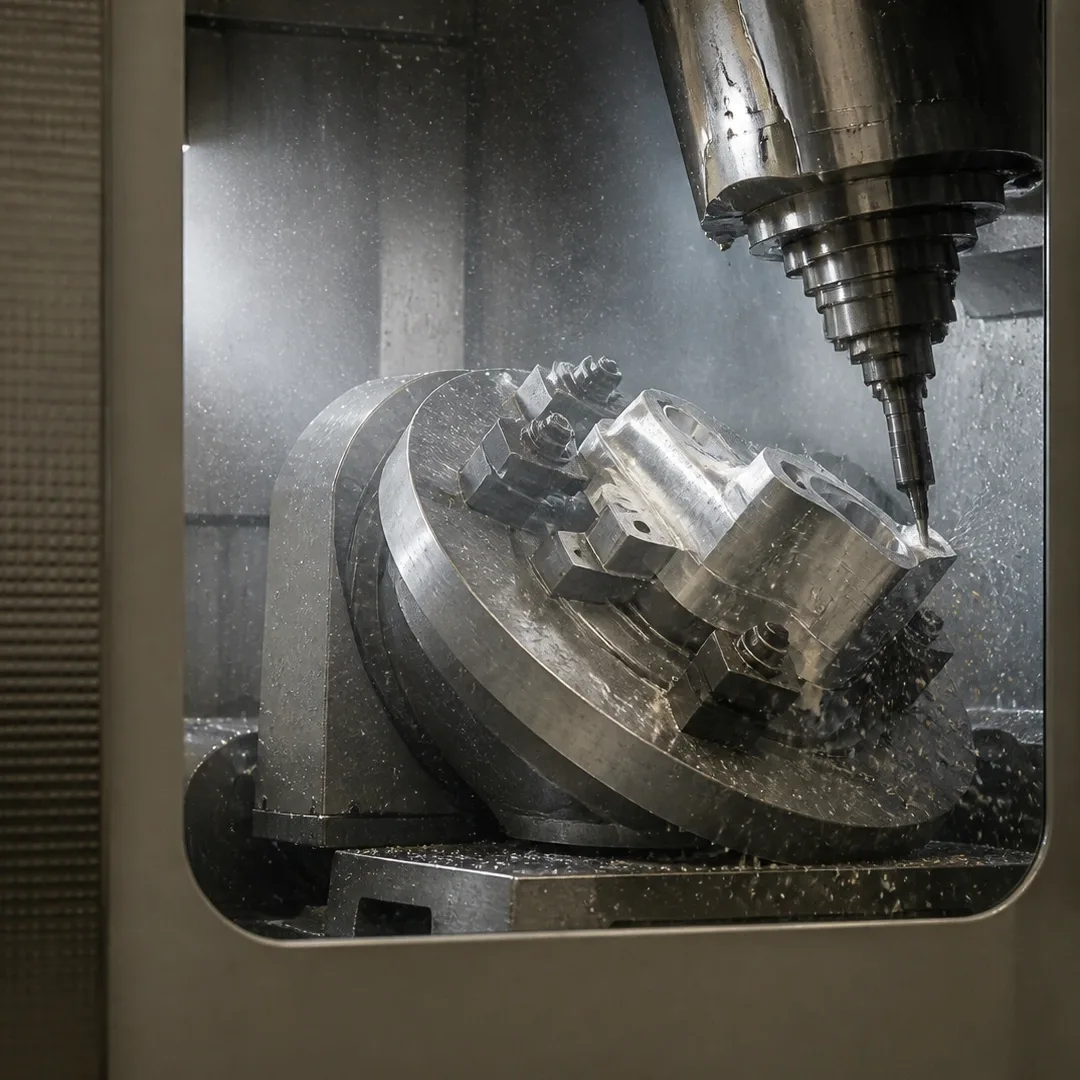
The part is held once. Single-setup, one-datum work is the rule, and five-axis machining is what makes it possible on compound geometry: every face is reached without re-fixturing, so a part that springs as stress is relieved is never asked to go back into a fixture it has already left. Tilting the head keeps the tool contact square to the wall, and the surface finish comes off the finishing pass instead of off a later operation that would rub a hardened skin.
The part is probed in the cycle. Tool wear in this alloy is fast and continuous, so a feature is checked in the cycle while it is still clamped and the tolerance stack is read mid-operation. A drift in the reading is a worn edge, and the edge is changed before the feature it would have spoiled is cut. Off the machine, the critical features are read again on independent instruments before the part ships.
This page prints no cutting speed and no feed. The right number depends on the tool, the holder, the engagement, the coolant, the condition of the alloy and the machine it runs on, and a figure lifted from a page and run on a different setup is how an insert dies in one pass. The setup decides the number; the number does not decide the setup.
◆04·WHEN IT GOES WRONG
What a too-fast cut does, and what a hesitation does.
A cutting speed set too high puts more heat at the edge than the coolant and the chip can carry away. The edge softens and deforms, stops cutting cleanly and starts rubbing, and rubbing hardens the surface it touches. From there every symptom follows in order: chatter as the force rises, dimensional drift as the tool loses its geometry, a burnished surface carrying tensile stress instead of a cut surface, and eventually an insert that breaks inside a part that was nearly finished.
A hesitation does the same damage from the other direction. A dwell at the end of a pass, a feed hold with the tool in the cut, a spring pass taken to clean up a wall: each of these rubs, and each leaves a hardened skin for the next tool to meet. That next tool is then asked to cut a material harder than the drawing specified, it wears out early or fails, and the failure gets blamed on the alloy.
Neither failure is a mystery, and neither is fixed by a different insert alone. Both are prevented in the program, before the first chip, which is where this shop puts the work.
◆Where the heat goes
Steel · the chip carries the heat away
Inconel 718 · the heat stays at the edge
Steel · the chip carries the heat away
Inconel 718 · the heat stays at the edge
THE HEAT STAYS AT THE EDGE
The alloy carries heat poorly, so little of it leaves with the chip; it runs back into the tool.
A RUB HARDENS THE SKIN
An edge that dwells or rubs leaves a harder surface behind it for the next pass to meet.
SO EVERY CUT COMMITS
The feed keeps the edge cutting from entry to exit, and a pass ends in air, not in the metal.
◆05·THE PART
Geometry first.
The material sets the rules; the geometry sets the difficulty. A simple block in Inconel 718 is slow but straightforward. A compound angle, a thin wall, a deep pocket, or a bore that has to hold position against three other features is where the alloy's habits and the part's geometry compound each other, because a long tool deflects, a re-clamped part moves, and a hardened skin in a pocket corner is unreachable for cleanup.
So the approach is geometry-first: the part is read for what it has to do and where it will move while it is cut, the hold and the datum are chosen for that, and the tool is kept short by tilting the head to the geometry rather than re-fixturing the part. Stiffness beats speed in this alloy every time.
◆06·TURNED WORK
On the lathe, the same rules hold.
Inconel 718 is turned here as well as milled, and turning changes the shape of the problem without changing its cause. On a lathe the cut is continuous and the chip has nowhere to end, so the tough chip described above becomes a ribbon that wraps the part and the tool unless the feed and the chip breaker were chosen for it. The heat still stays at the edge, and as the diameter falls under a facing pass or a taper the edge would see a different speed at every moment unless the program holds the surface speed constant; it does, and the edge sees one heat from the outside of the stock to the last pass.
The hold is short and rigid: the stock gripped close to the cut, the overhang kept to what the part needs, the far end supported where the length asks for it, because a long bar in 718 deflects away from the tool, rubs, and hardens the surface it was meant to cut. The insert is sharp and known before it touches metal, the feed commits from entry to exit, and an interrupted cut, a flat or a keyway already in the bar, is planned into the program rather than discovered by the edge.
A journal or a bore in this alloy is finished in a pass that cannot be taken twice, so the diameter is measured while the part is still in the chuck, and the critical diameters are read again on the bench on independent instruments before the part ships.
◆07·WHAT TO SEND
What the quote is built from.
Send the print or the model with the material condition on it: annealed, solution treated, or solution treated and aged. The condition decides the setup, because the aged alloy is the harder one to cut and the one most parts are finished in. Mark the features that matter and say the finish in words on the print. With no drawing at all, the part itself is measured and the work proceeds from that.
What moves the number is machine time, because the cutting is slower than in steel; tooling, because edges are consumed; the number of setups the geometry demands, which five-axis work reduces; and the inspection the print calls for. There is no price on this page and no promised date, because both are read from the part in hand.
THE QUESTIONS PEOPLE ACTUALLY TYPE
Asked by people holding a print in 718.
8 answers. Asked by the people who hold a print in 718 and have to get it quoted somewhere.
Why is Inconel 718 difficult to machine?
It keeps its strength at the temperatures cutting creates, it conducts heat poorly so the heat stays in the tool, it work-hardens under a tool that rubs instead of cuts, and its chip is tough and abrasive. Each of those is handled in the setup rather than at the spindle.
How hard is it to machine Inconel?
It is ordinary work in a shop set up for it and a tool-breaking exercise in one that is not. The difference is feed discipline, a rigid single-setup hold, a measured sharp edge, coolant on the edge and probing in the cycle, all decided before the first chip.
What is the recommended cutting speed for Inconel 718?
There is no number worth printing. It depends on the tool, the holder, the engagement, the coolant, the alloy's condition and the machine, and a figure lifted from a page and run on a different setup kills an insert in one pass. The setup decides the speed.
What happens if the cutting speed is too high?
The edge overheats and deforms, stops cutting and starts rubbing, and the rubbed surface work-hardens. Chatter, dimensional drift, a burnished surface and a broken insert follow, in that order.
What are the disadvantages of Inconel?
It is expensive to buy, slow to machine, hard on tooling, and dense compared with titanium for the same strength. It earns its place where a part must keep its strength at high temperature; where it does not, a different alloy is usually the right answer.
Is Inconel the hardest metal to machine?
It is among the hardest common engineering alloys to machine, and the difficulty is heat and work-hardening rather than hardness alone. Some materials are harder still; few combine all four of its habits at once.
Will you machine one part in Inconel 718?
Yes. One part in Inconel 718 is quoted from the print like any other job. Send the drawing, the model, or the part.
Can Inconel 718 be turned?
Yes. Turned work in 718 runs on a CNC lathe here by the same rules as the milled work: a short rigid hold, a sharp measured insert, a feed that commits, coolant on the edge, and the surface speed held constant as the diameter changes. The ribbon chip is the lathe's own problem, and it is solved in the program with the feed and the breaker, not at the spindle.
Sources
They support the general facts. The shop practice is its own.
- The alloy producer's data sheetComposition, heat treatment, and the condition it is bought in for machining.
- NASA's materials data handbook for the alloyProperties from cryogenic to elevated temperature, with fabrication and joining.
- How the edge shape of a tool drives work hardeningAn open-access study of the hardened layer a cut leaves behind.
Send the print, with the material condition on it.
Annealed, solution treated, or solution treated and aged: the condition decides the setup, and the setup decides everything else. Mark the features that matter and say the finish in words. One part in this alloy is quoted as a real job because it is one.