STOPPED WHERE FOUND · A PHOTOGRAPH AND A CALL · THE SAME BUILDING
A photograph and a call, before anything else.
THE BLAST · THE CUT · THE CALL
WHAT DOES A SHOP DO WHEN THE BLAST OR THE CUT FINDS A CRACK, A VOID OR A WALL THAT MOVED?
The work stops at the feature, the part is photographed where it sits, and you get the call: what was found, where it sits against the features that matter, and what the choices are. Nothing is cut further, welded or scrapped until you decide, and because honing, TIG welding, shot peening, five-axis machining and hand work all happen under this roof, the part can carry on to what it needs instead of into another box.
By Cyclone Machining Co.Updated
◆01·WHAT THE BLAST UNCOVERS
A blast takes the skin off whatever was hiding under it.
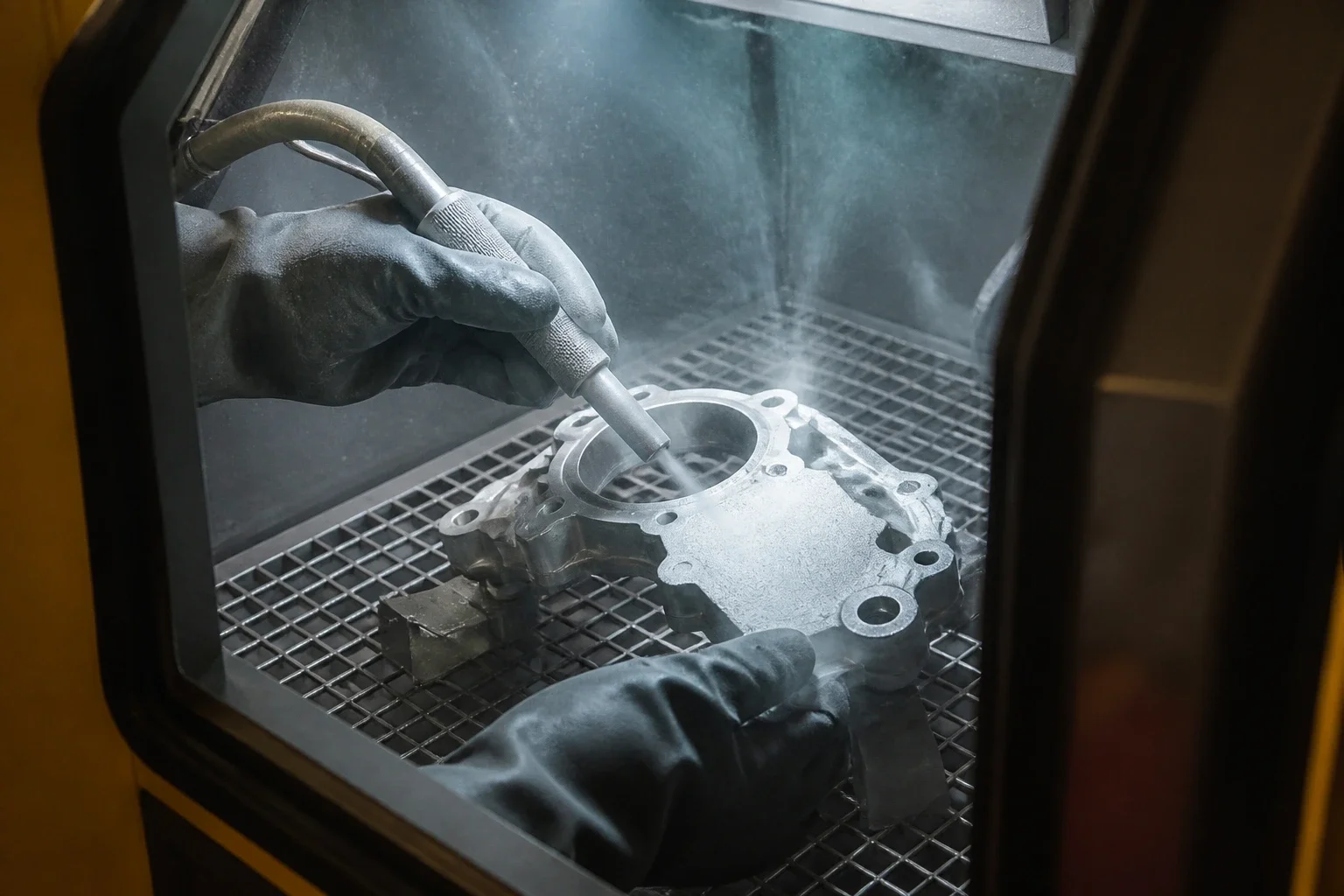
Oxide, carbon, old coating and years of handling hide a surface, and a blast removes them evenly, which is why the first honest look at a part often happens in the cabinet. A thread that has pulled, a mating face that has fretted against its neighbour, a hairline crack running from the root of a boss, a casting skin that was covering porosity: none of these show under the dirt, and all of them show the moment it is gone.
That is the moment the blast is most useful and the moment it can be most expensive to ignore. A shop that only cleans has to hand the part back with the news and nothing else. Here the cabinet is a few steps from the machines, so what the blast finds is looked at by the people who would fix it, before the part goes anywhere.
◆02·WHAT THE CUT UNCOVERS
The tool opens things a print never drew.
Porosity opens on a sealing face when the finishing pass reaches the depth where the gas was trapped as the metal froze. A wall walks when the cut releases stress the casting or the bar has been holding since it was made. A bore that measured round before the skin came off measures out of round after it, because the skin was carrying the shape. A void appears in the middle of a boss where the last metal to freeze had nothing to feed it.
None of these is a mistake in the cutting, and all of them are found by it. What matters is what happens in the next minute: whether the tool keeps going to see how deep the problem runs, or stops so that the decision belongs to the person whose part it is.
◆03·STOPPED WHERE FOUND
Nobody keeps cutting to see how far it goes.
The operation stops at the feature. The part stays in its setup so nothing is lost, it is photographed where it sits with the finding in frame, and the feature is measured: where the void or the crack lies against the features that have to seal, locate or carry load, and how much material is left around it. Cutting on to explore a defect destroys the evidence and sometimes the part, so it is not done.
The photographs and the readings are yours. They go with the call, so a decision made on the phone can be understood later by anyone who has to read the part's history, including a customer of yours who never saw the casting.
◆Stopped where found
UNDER THE SKIN
Porosity opens on a sealing face when the finishing pass reaches the depth where the gas was trapped as the metal froze; no look at the outside can show it.
STOPPED AT THE FEATURE
The operation stops where the finding is and the part stays in its setup so nothing is lost; cutting on to explore a defect destroys the evidence, so it is not done.
THE CALL
What was found, where it sits against the faces that have to seal, locate or carry load, and what the choices are, with the photograph; nothing is cut further, welded or scrapped until you decide.
◆04·THE CALL
What was found, where it sits, and what the choices are.
The call says three things. What was found, in plain words and with the photograph. Where it sits: whether it opens onto a face that has to seal, a bore that has to locate, a wall that has to carry a load, or a surface nobody will ever see, because the same void means different things in those four places. And what the choices are, with what each keeps and what each costs, in words.
The decision is yours, and it is not rushed. A part can sit in its setup while you talk to the person the part is for. What the shop will not do is make the decision for you by cutting, welding or scrapping before you have heard the call.
◆05·THE SAME BUILDING
Where the part carries on, and where it does not.
Because the finishing and the machining are under one roof, most findings have a route that does not involve a box. A pulled thread is drilled out and a new one cut. A fretted face is skimmed true and re-measured. A crack beside a boss, if the print and the material allow it, is opened, TIG welded and re-cut, then blasted or peened with the rest of the part. A bore that will clean up is honed until it does; a bore that will not is told the truth about.
The route this page does not describe is the one where a worn thing is brought in to be made like new. Damage found inside a job that is being built new to a print, or on a part that came here to be measured and re-made, is this page. A cracked tool brought in only to be welded and sent back, a worn engine, a classic-car casting brought in for its own sake, are not the work here, and you are told so on the first call.
◆06·A CASTING, BEFORE THE FIRST CUT
What is checked before the tool touches it, and what only the cut can show.
A casting is looked at before it is cut: the skin, the parting line, the gates and risers, the faces that will become datums, and whether it sits in the fixture the way the print assumes it will. Obvious cracks, cold shuts and a skin that is already open are found here, and a casting that is wrong before it is cut is reported before it is cut, so the foundry conversation happens while a replacement is still cheap.
What no inspection of a skin can show is what lies under it, and that is the honest limit. Porosity under a face and a void inside a boss are found by the cut that reaches them or by an inspection method the print calls for, and the shop will say which of those a given feature depends on rather than promise that a look at the outside settled it.
◆07·WHAT TO SEND
The part, the print, and what it has to do.
Send the part and the print, and say what the part has to do: which faces seal, which bores locate, which walls carry load, and what it mates with. That is what turns a finding into a decision, because it is what decides whether a void on a given face matters at all. If the casting has a history, a foundry report or a failed sibling, send that too.
There is no figure on this page for how deep a crack can be or how much porosity is acceptable, because the print and the feature decide it, part by part. What there is, is a call before anything else happens, from a person who has the part in front of them.
THE QUESTIONS PEOPLE ACTUALLY TYPE
Asked by people who just got the call.
8 answers. The questions that follow a finding, including the ones typed into a search bar at the same moment.
What counts as damage found?
Anything the print did not draw that the blast or the cut revealed: a crack, a void, porosity opening on a face, a thread that has pulled, a mating face that has fretted, a wall that moved when stress came out, a bore that stopped being round once the skin came off. Each is photographed where it sits and measured against the features that matter before anyone decides anything.
Will you keep cutting to see how far it goes?
No. Cutting on to explore a defect destroys the evidence and sometimes the part. The operation stops at the feature, the part stays in its setup, and the finding is photographed and measured so the decision can be made with the facts rather than after them.
Can the part carry on in the same building?
Usually. Honing, shot peening, wet and dry blasting, TIG welding, five-axis machining and hand work are all here, so a finding has a route that does not involve shipping the part somewhere else and waiting. Which route, and whether one exists, is what the call is for.
What if it cannot be saved?
Then you are told plainly, with the photographs and the readings, and the part comes back as it stands so you and the person it is for can see exactly what was found. A part is never scrapped here on the shop's own decision.
Is a cracked tool brought in for repair the same thing?
No. This page is about damage that shows itself inside a job already here, on a part being built new to a print or measured and re-made. A cracked tool brought in only to be welded up and returned to the press, a worn engine, or a classic-car casting brought in for its own sake is not the work here, and you are told so on the first call.
What causes a crack or porosity in a casting?
Gas trapped in the metal as it froze leaves porosity; a section that froze last with nothing left to feed it leaves a shrinkage void; a casting held rigid while it shrank can tear while still hot; and stress locked in as it cooled can let go when a cut removes the material that was holding it. None of that is visible on the skin, which is why the cut so often finds it first.
How much porosity is acceptable?
The print decides, and a sealing face decides differently from a face nobody sees. No figure is given here because one would be read as a rule for your part; instead you are shown where the porosity sits, how the feature reads against the print, and what the choices are, and the call is yours.
Do you look at a casting before the first cut?
Yes: the skin, the parting line, the gates and risers, the datum faces and how it sits in the fixture. A casting that is wrong before it is cut is reported before it is cut. What lies under the skin is found by the cut that reaches it or by the inspection the print calls for, and the shop says which.
Sources
They support the general facts. The shop practice is its own.
- What the common casting defects areGas porosity, shrinkage, hot tears and cold shuts, and where in a casting each one forms.
- What residual stress isStress locked into a part as it was made, and why a cut can release it.
Send the part, and say what it has to do.
Which faces seal, which bores locate, which walls carry load: that is what turns a finding into a decision. If the blast or the cut uncovers something, the work stops where it found it and you get the call, from the building the fix would happen in.